

PowerLahn: First combined heat and power plant in Hesse
On 2 July 2026, Stadtwerke Gießen inaugurated the innovative combined heat and power plant ‘PowerLahn’.
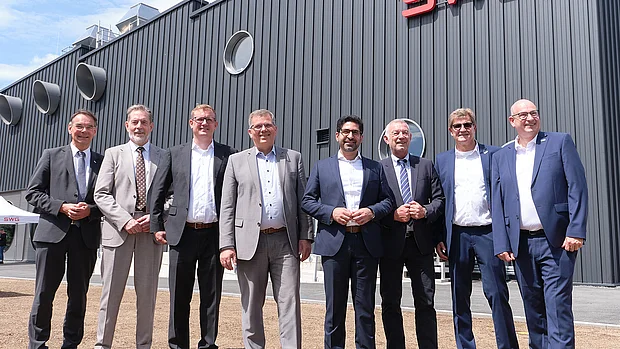
On 2 July 2026, Stadtwerke Gießen inaugurated the innovative combined heat and power plant ‘PowerLahn’.
CO₂-neutral heat for around 3,900 homes – that is how much Stadtwerke Gießen (SWG) will now produce with its new innovative combined heat and power plant (iCHP). To be more precise, this amount of heat is generated solely at the heart of this three-component hybrid generation system: in the newly built energy centre on the River Lahn, three efficient, large-scale heat pumps – powered by green electricity – extract the necessary energy from the flowing river. “The name PowerLahn really says it all,” explains Matthias Funk, CEO of SWG, at the official opening on 2 July 2026. The other two components – two combined heat and power (CHP) plants and a so-called power-to-heat (P2H) module – are located at SWG’s Leihgesterner Weg site. This is the spot where, until a few months ago, two gas turbines were still in operation.
More than a hundred guests
Owing to the symbolic significance of “PowerLahn”, numerous guests of honour from the worlds of politics, business and academia accepted SWG’s invitation to celebrate the inauguration together. Hessian Minister of State Kaweh Mansoori, Manfred Becker representing the Giessen Regional Council, Lord Mayor Frank-Tilo Becher and SWG Supervisory Board Chairman Alexander Wright all addressed the visitors with welcoming remarks. Ingbert Liebing, Chief Executive of the Association of Municipal Enterprises, and Dr Hansjörg Roll, President of the AGFW – Energy Efficiency Association for Heating, Cooling and CHP, paid tribute in their speeches to the SWG’s work in this still relatively new field of heat generation. Also in attendance at the inauguration were District Administrator Anita Schneider, mayors from neighbouring municipalities and representatives from Giessen’s universities. In total, SWG welcomed more than 100 guests to its celebration on Schlachthofstraße.
Multiple benefits
Following the welcome by Alexander Wright and the two hosts – SWG board members Matthias Funk and Andreas Hergaß – the speakers highlighted the numerous positive aspects of PowerLahn. The most obvious advantage of the plant lies in its contribution to climate protection and, consequently, the local energy transition. Efficient energy conversion plays a particularly significant role in this regard. However, the P2H module also deserves attention. This technical term is used by experts to describe a large-scale direct electric heating system. Integrated into the overall system, it kicks in whenever an extremely large amount of green electricity is generated on sunny and windy days. “The P2H module takes the strain off the electricity grid and ensures that PV and wind power plants need to be taken off the grid less frequently,” says SWG board member Matthias Funk, describing how this component is used.
The third key point has gained significance in recent years and is becoming increasingly important: PowerLahn reduces dependence on energy imports. “SWG is once again demonstrating what is already possible today and the direction we need to take,” says SWG Supervisory Board Chairman Alexander Wright, praising the construction of this pioneering plant, and adds: “PowerLahn is a flagship project with an impact extending far beyond the region and a model for other municipal energy suppliers.”
All this makes PowerLahn a new cornerstone of SWG’s strategy. In fact, SWG has been consistently pursuing the goal of gradually phasing out fossil fuels in heat generation for many years. This is precisely what makes the plant a key factor in a local authority initiative: the city of Giessen aims to achieve climate neutrality by 2035. And this is exactly where PowerLahn makes a significant contribution.
Figures that speak for themselves
SWG has invested around 30 million euros in its iKWK plant. The three large heat pumps on the River Lahn alone will supply around 29 million kilowatt-hours of heat annually in future. The two CHP units generate approximately 50 million kilowatt-hours of heat per year. This is sufficient to provide heating and hot water for around 6,800 homes. On top of that, the CHP plants generate a further 47 million kilowatt-hours of electricity per year. This is enough to meet the needs of around 21,000 homes.
The reduction inCO₂ emissions amounts to an impressive 10,500 tonnes per year for the entire system. This figure is based on the fact that the three optimally coordinated components replace not only the former gas turbines but also individual gas-fired boilers. And with these savings, there is still plenty of scope for further improvements. This is because SWG currently still operates both CHP units on natural gas. “Of course, we can also run the units on biomethane or hydrogen – depending on which of these fuels is available in sufficient quantities in future,” announces Matthias Funk. Following such a switch, PowerLahn would operate entirely climate-neutrally.