
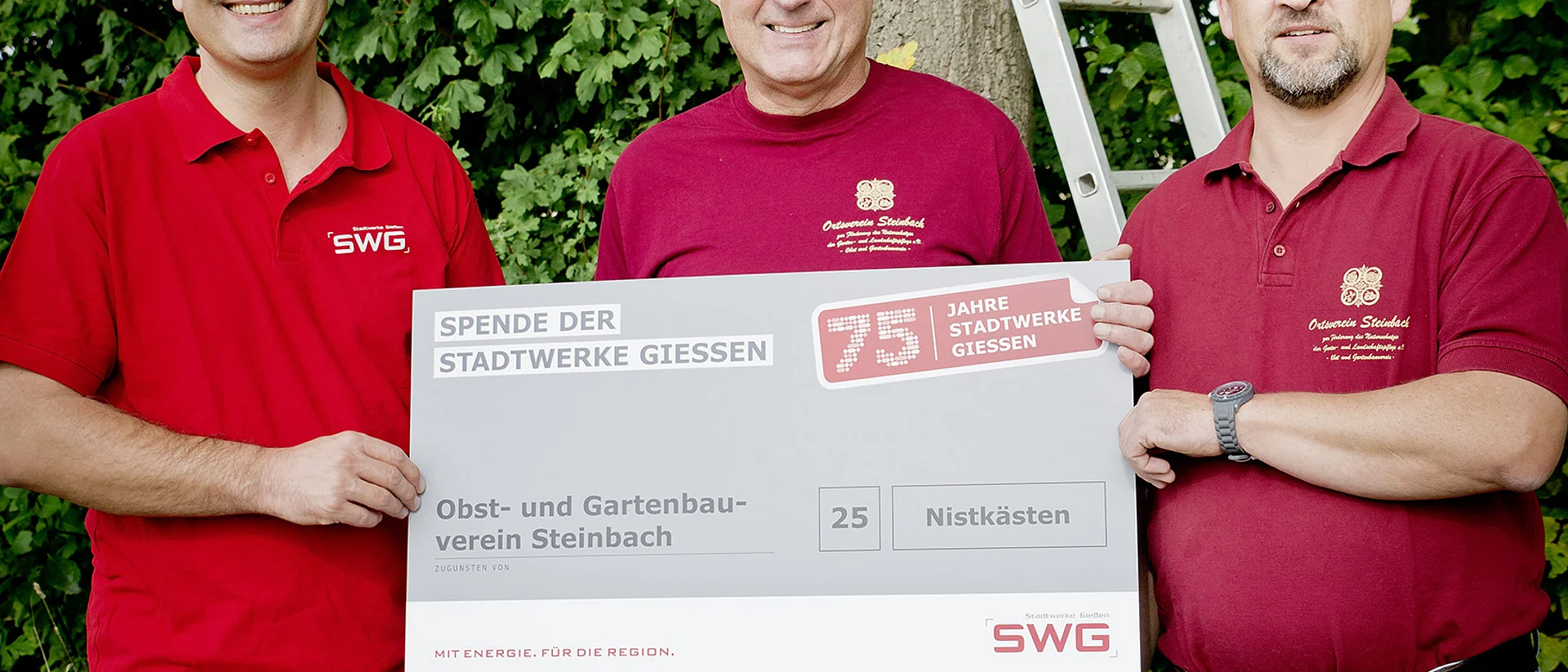

25 new nesting places made of wood-concrete: Stadtwerke Giessen supports the Steinbach Fruit and Horticultural Association in its commitment to regional bird protection.
Giessen. With the first frosty nights approaching, it's high time for the Steinbach Fruit and Horticultural Association to winterise the nesting boxes it looks after in the region for native songbirds. This is because great tits, blue tits, sparrows and blue flycatchers not only raise their young there in spring and summer - in the cold season, they mainly serve as a warm roost and sometimes save their lives.
Herbert Stelzer, the association's bird warden, and his colleagues from the bird protection department therefore have until the end of October to clean, maintain and - if necessary - replace all 140 nesting boxes. The Friends of Nature are receiving help from Stadtwerke Gießen (SWG). As part of its 75 good deeds, SWG is donating a total of 25 new nesting boxes made of wood-concrete to the association. Herbert Stelzer explains: "We are replacing 13 old nesting boxes whose material is now unusable. We are installing the remaining shelters at additional locations. These include the new commuter car park in Steinbach and the footpath and cycle path to Lich."
Mathias Carl, Managing Director of SWG subsidiary MIT.BUS GmbH, lent a hand himself and helped the bird conservationists replace the nesting boxes. After his work, the sponsor of the good deed handed over the symbolic donation cheque to Herbert Stelzer and Thomas Fesel, the Steinbach fruit and gardening association's accountant. Mathias Carl is a passive member of the Steinbach fruit and gardening association and is delighted that his employer is supporting environmental and nature conservation in the region with a good deed: "Many volunteers are committed to preserving the flora and fauna here in Central Hesse in their free time. That deserves recognition and help."
With the artificial nesting aids, the fruit and horticultural association has been actively protecting nature for many decades. They can be found wherever natural cavities such as old and rotten trees or buildings with suitable breeding niches are lacking. In Steinbach, they are mainly located on the entry and exit roads, on the footpath and cycle path to Annerod and Lich and at the new commuter car park.