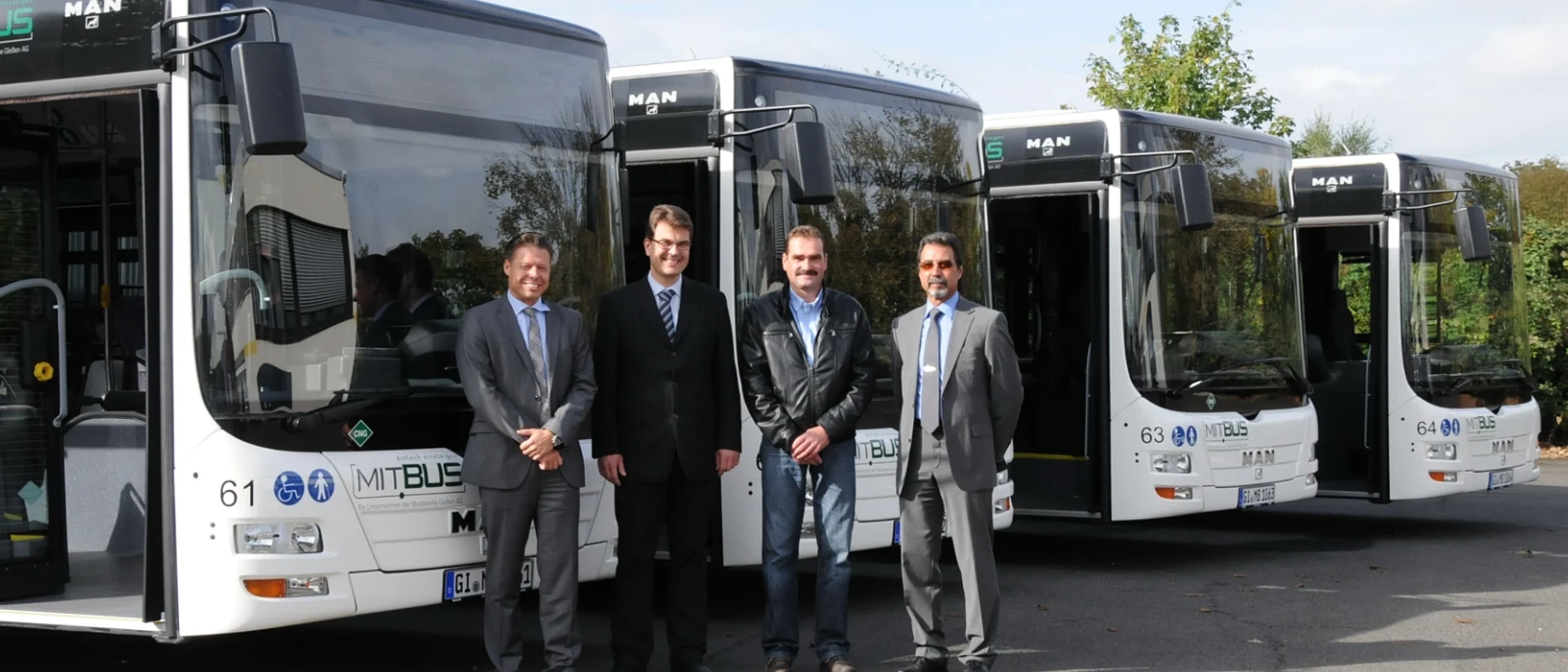

Giessen. From 15 October, four more articulated buses with natural gas engines will be running on Giessen's regular routes, replacing four so-called solo buses with conventional diesel engines. MIT.BUS GmbH, a subsidiary of Stadtwerke Gießen, is thus significantly increasing its capacity. In future, the new vehicles will be used on route 1, among others - a route on which shorter solo buses have been operating up to now. MAN had already handed over the new Lion's City G vehicles on Friday, 28 September.
MIT.BUS has been systematically converting its bus fleet to the climate-friendly natural gas drive since 2006. In the meantime, 28 of the 53 low-floor buses already run on natural gas. The experience of switching to the alternative fuel has been consistently positive. MIT.BUS Managing Director Mathias Carl: "The engines have proven their worth and reliability in everyday transport. That's why our gas fleet will continue to grow in the coming years."
Less particulate matter and nitrogen oxides
The gradual switch from diesel to natural gas is also helping to reduce the particulate matter emissions caused by local transport in Giessen. The natural gas buses are also characterised by a significantly lower noise level. "The alternative natural gas drive has great strengths in terms of climate protection and economy," Mathias Carl is convinced. Compared to the diesel engines of the buses used to date, the natural gas drive of the new vehicles reduces nitrogen oxide emissions by at least 60 per cent, for example, as they meet the EURO 5/EEV standard.
From the outside, however, the natural gas buses hardly differ from diesel vehicles. However, there is one feature that makes them easy to identify. On the roof - in the front section just before the joint - a bonnet curves upwards, under which the natural gas storage tanks with a tank capacity of 1460 litres are located. From there, the fuel flows into the 310 hp petrol engine at the rear of the 18-metre-long vehicle. "This entire system with robust and impact-resistant aluminium composite cylinders has been put through its paces by the manufacturers in numerous crash tests. Passengers can therefore rest assured that they are just as safe travelling in the natural gas vehicles as in our diesel vehicles," emphasises Mathias Carl.
All new vehicles have air conditioning and - like the other MIT.BUS vehicles - low-floor technology. This means that the vehicle floor is very low, which makes it easier for parents with pushchairs, wheelchair users or people with walking difficulties to get on and off. The vehicle can also be lowered sideways if required. Passengers can get help from the bus driver by tapping the blue button with the wheelchair and pushchair symbol inside or outside the bus. Mathias Carl is delighted: "The modern buses enable climate-friendly and comfortable local transport."