


Making biogas production sustainable
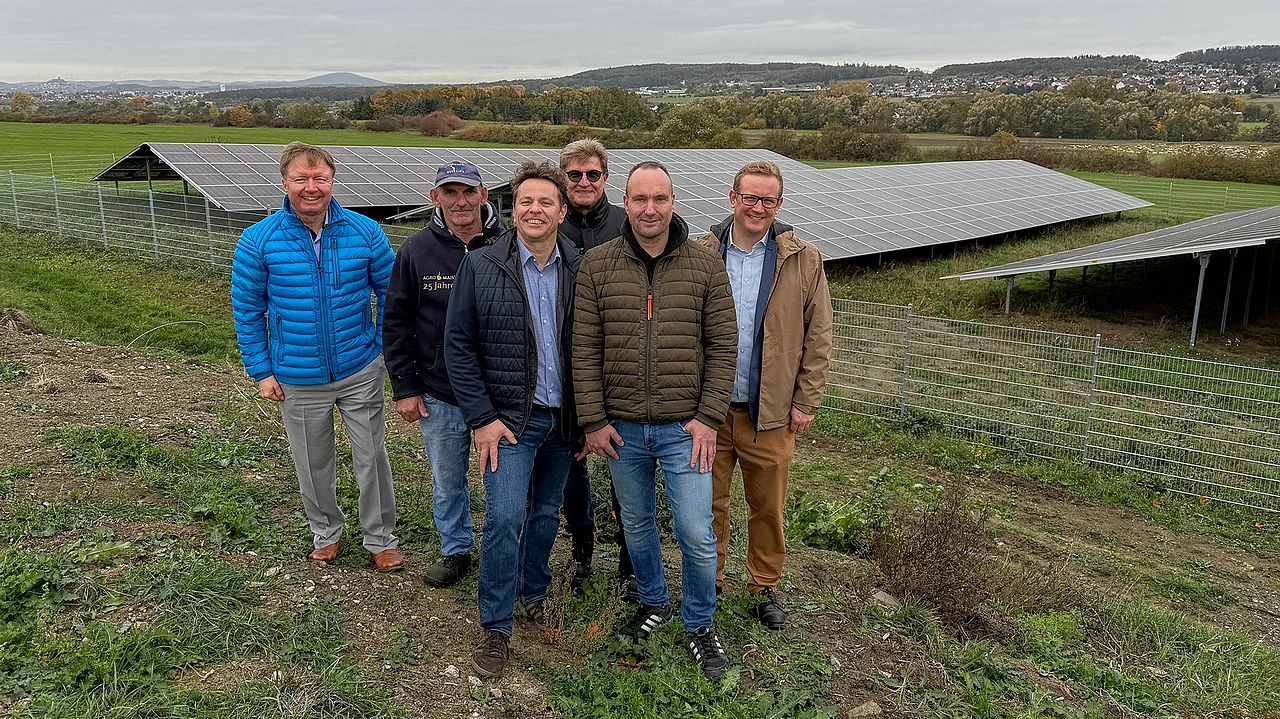
MIT.BIO Biogasanlage Großen-Buseck GmbH, a subsidiary of Stadtwerke Gießen, has installed a ground-mounted solar array on its site.
Since 2011, biogas has been produced from grass, maize and farmyard manure at Marco Klos’s farm in Großen-Buseck. The two combined heat and power units, which are also part of the plant, have so far converted this constantly generated natural fuel into around 36,400 megawatt-hours of heat and approximately 29,400 megawatt-hours of electricity. To ensure this success story continues into the future, those in charge decided to install a photovoltaic system. “We need around 325,000 kilowatt-hours of electricity annually to run the plant – for example, to power the powerful agitators. We now generate around 50 per cent of this ourselves using solar power,” says Matthias Funk, explaining the approach. The chairman of Stadtwerke Gießen (SWG) is one of the managing directors of MIT.BIO Biogasanlage Großen-Buseck GmbH (MIT.BIO).
A lengthy lead-up
The solar power station went into regular operation as early as September 2026, following a trial run lasting around one month. Planning for this innovative project began some four years ago. “We held the first discussions on this in early 2022,” recalls Besim Krasnici. As a co-shareholder of MIT.BIO, the civil engineer also holds a seat on the management board. At the end of 2023, the process for drawing up the development plan began, and this was completed as early as September 2024. “We would like to take this opportunity to express our sincere thanks for the excellent cooperation with the municipality of Buseck. The relevant staff at the town hall were always approachable and responded immediately to our enquiries,” adds Besim Krasnici. Thanks to this close cooperation, it was possible to finalise the plans by the end of 2025, put the construction work out to tender and award the contract. Construction work began in January this year.
The ground-mounted PV system, with its 570 modules and a peak output of 340 kilowatts, produces around 300,000 kilowatt-hours of electricity annually. In purely mathematical terms, this is almost enough to power the biogas plant. However, despite the modules being oriented at a slight angle towards the east and west, the electricity is naturally not always generated when it is needed to produce biogas. For this reason, the overall system is equipped with a battery storage unit with a capacity of 215 kilowatt-hours. “This allows us to supply the biogas plant with electricity for five to six hours,” calculates Matthias Funk, before announcing the next step: “We have designed the housing containing the battery module so that we can add further modules and triple the storage capacity.”
Thinking even further ahead
However, additional battery storage units are not the only expansion option being considered by those in charge. This is because the two hectares earmarked for development still offer space for further solar panels. So far, the PV system occupies around a third of the available area. “We have designated about a quarter as a compensation area. A biotope is being created here,” explains Besim Krasnici. That leaves a good 8,000 square metres to expand the existing PV system – theoretically to more than double its output.
There are various reasons why the experts did not want to utilise the entire available area from the outset. One lies in the comparatively long period between initial planning and construction. In 2022, electricity storage systems were still much more expensive than they are today. “Based on the costs to be assumed at the time, it proved more sensible to design the PV system on a significantly smaller scale and thus tailor it to the biogas plant’s electricity requirements,” says Matthias Funk, explaining the approach. It is important to note that feeding PV electricity into the grid is no longer the driving factor. “The economic benefit lies in maximising self-consumption,” says Matthias Funk.
Furthermore, with a project structured in this way, it makes sense to start small, gain experience and then gradually expand the system. That is precisely what those in charge intend to do: “We will closely monitor how electricity production develops and how the current set-up performs economically. These verified figures will then provide the ideal basis for further planning,” summarises Besim Krasnici.