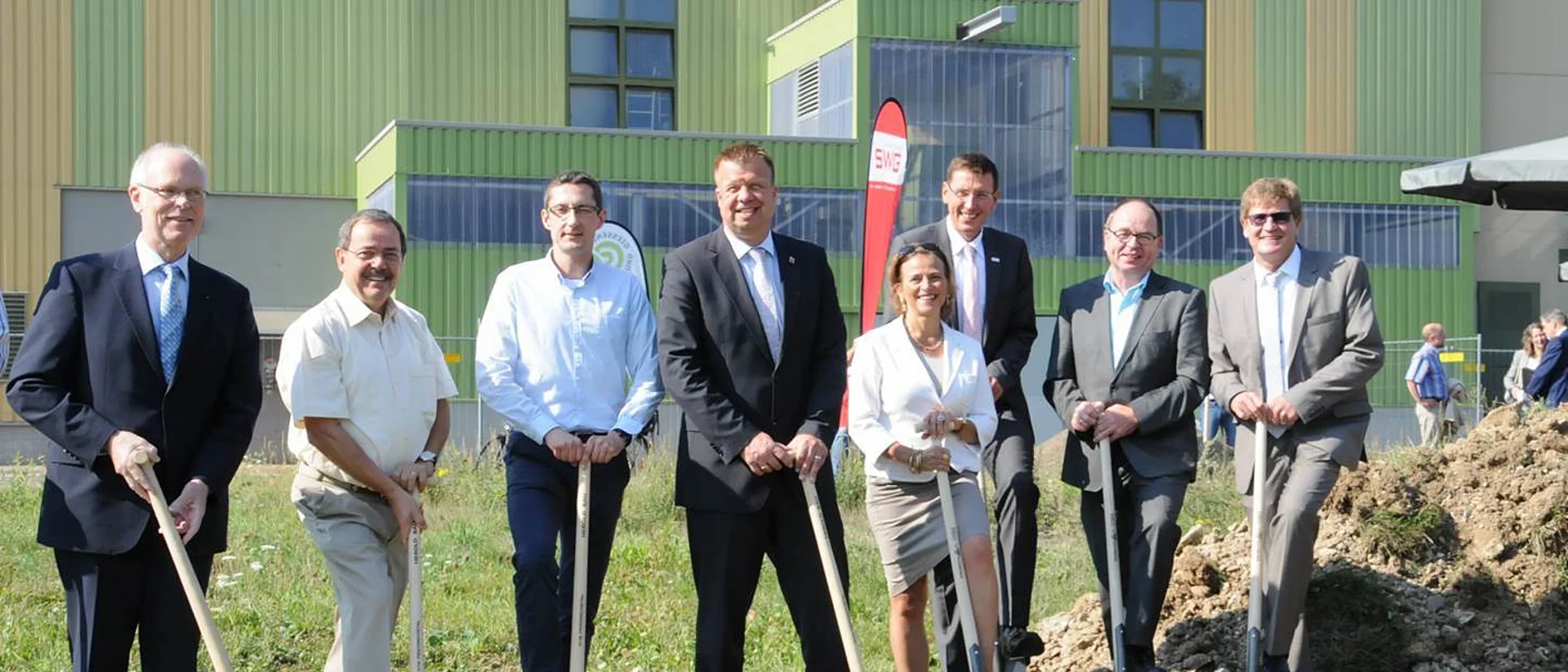

Construction work on TREA 2 begins on 21 August 2015 with the official ground-breaking ceremony. Like TREA 1, the new plant will also utilise processed waste. This means that TREA 2 will not only generate heat, but also electricity.
The energy transition in the region takes another major step forward: on 21 August, the starting signal is given for the construction work on TREA 2. With the new combined heat and power plant, SWG is once again entering new technical territory. Instead of copying the first, highly efficient TREA and improving it in detail, the engineers at SWG are taking a new approach: TREA 2 will generate electricity as well as heat.
TREA stands for thermal residue treatment and energy utilisation plant. The plant burns medium-calorific waste - so-called substitute fuel - and thus generates thermal energy. Although the resulting temperatures are sufficient to generate hot water and steam for the district heating network, they are too low to produce electricity economically. However, this is exactly what the engineers responsible at the municipal utilities wanted to achieve. "So we had to come up with a way of superheating the steam that we produce by incinerating the waste so that we can use it to drive a generator," explains Matthias Funk, Technical Director of Stadtwerke Gießen, who welcomed the attendees.
With their completely new concept, the SWG planners are once again doing pioneering work in terms of efficiency. In order to solve the problem of low temperatures, the experts are utilising tried and tested technology: two combined heat and power units (CHP units) provide the necessary temperature increase. The exhaust gases from these efficient units are so hot that they raise the steam to over 350 degrees Celsius - enough to produce electricity.
Innovative and reliable duo
In addition to high energy efficiency, the combination of waste incineration and two gas-fuelled CHP units offers another advantage that should not be underestimated: the overall system is extremely variable. "We can operate the TREA 2 in the range of 1.3 to 5.5 megawatts of electrical output. This will allow us to react very flexibly to the market situation in future," says Funk.
Based on the positive experience with the first TREA and the CHP modules, Matthias Funk and Matthias Fink, Head of the Heat Supply department and as such responsible for the project, calculate a conceivable annual operating performance of around 7400 hours. This means that TREA 2 produces enough heat to cover the needs of around 4,200 single-family homes. Overall, the experts at Stadtwerke expect the plant to generate around 75 million kilowatt hours of heat per year.
The expected electricity yield of TREA 2 is also impressive: with a total system output of 5.5 megawatts, the forecast electricity production is around 40,600 megawatt hours. Enough to supply around 13,500 average households with electricity. However, the TREA 2 will not quite achieve these values under real operating conditions. After all, the plant is designed for flexibility. And that means that it will not operate at full capacity all the time.
Own production increases noticeably
With TREA 2, SWG will increase its own generation ofCO2-neutral electricity to 180,000 megawatt hours per year. In addition, the plant being built directly next to the first TREA will in future provide 17 per cent of the heat required in the SWG grid. In return, the municipal utilities will be able to switch off older, less efficient plants.
This will have a positive impact on the already excellent environmental footprint of SWG district heating. "Even if we calculate conservatively, we assume that TREA 2 will reduce our primary energy factor in Giessen from an already very good 0.36 to well below 0.2," Matthias Fink calculates. The primary energy factor stands for the ratio of fossil fuels used to the heat produced. In concrete terms, this means that once TREA 2 is commissioned, Stadtwerke Gießen will only have to use less than 0.2 kilowatt hours of natural gas to produce one kilowatt hour of heat.
Clean all round
It goes without saying that TREA 2 also fulfils all current environmental protection requirements. The solid combustion residues are free of toxins and can be used in road construction. As in TREA 1, sophisticated flue gas cleaning technology ensures that no hazardous pollutants are released into the environment via the chimney.
District President Dr Lars Witteck was also present at the ground-breaking ceremony. He praised the commitment of the municipal utilities: "With TREA 2, SWG is once again breaking new ground. As the responsible approval authority, we have had a good insight into the innovative concept for some time. In my opinion, this new TREA is another milestone for the energy transition in the region." The words of welcome from the Mayor of Giessen, Dietlind Grabe-Bolz, also went in this direction: "With TREA 2, Stadtwerke Giessen is making the heat and electricity supply in Giessen and the region a good deal cleaner and more efficient." In fact, the new plant offers decisive environmental benefits. Every year, it replaces the use of around 8.5 million litres of heating oil - that is as much as around 470 tankers can transport. This saves the environment 28,000 tonnes of climate-damaging carbon dioxide every year. What's more, the most important fuel - the processed waste - comes from the region. "In addition to a broad diversification of fuels, we make sure that as much of the added value as possible remains in the region when designing each generation plant," explains Matthias Funk at the ground-breaking ceremony. "With this approach, we are emphasising that we take our slogan 'With energy. For the region.' seriously and live by it."
Also present at the ground-breaking ceremony were representatives of the citizens' initiative "Lebenswertes Gießen", the commercial director of SWG, Jens Schmidt, and the two former SWG board members, Reinhard Paul and Manfred Siekmann.