
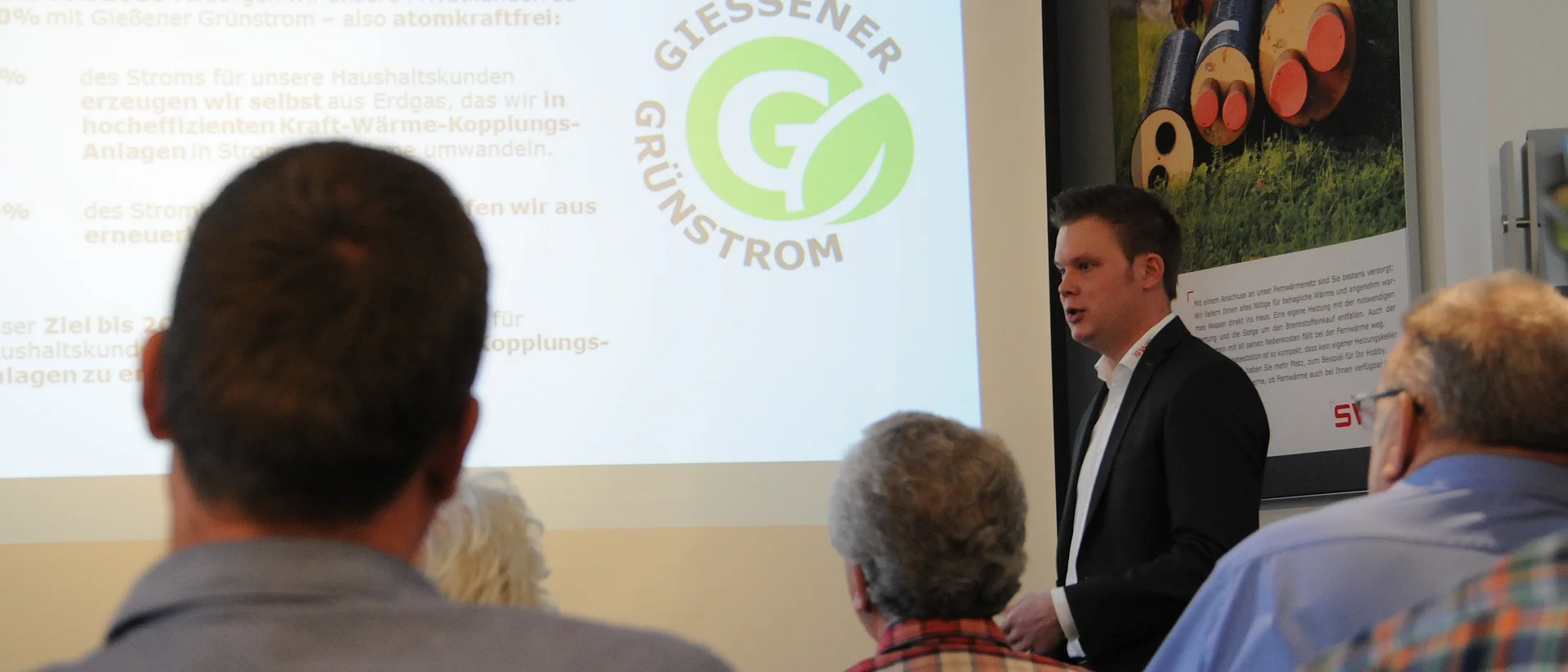


If you want to let or sell your home, you need an energy performance certificate. This year, an above-average number of certificates are due to expire. At a presentation, Stadtwerke Gießen provided information on what property owners need to know and why the energy performance certificate is worthwhile even without an obligation.
An energy certificate provides information about the energy requirements of a house. Generally speaking, the lower the expected consumption, the more attractive the building or flat. Since 2008, property owners have been legally obliged to present the certificate to tenants or buyers at the latest when signing a contract. Certain information must already be included in adverts on online platforms or in daily newspapers.
Legislators further tightened the regulations with the 2016 Energy Saving Ordinance. Stadtwerke Gießen (SWG) explained the changes and other important background information at a presentation in the SWG customer centre on the market square in Gießen on Monday, 9 April. Energy consultant Tobias Jakobi explained: "Generally speaking, there are two types of energy certificate - consumption-based and demand-based. For new buildings, only the consumption-based certificate is now permitted. This also applies to properties with up to four flats that do not comply with the 1977 Thermal Insulation Ordinance. Owners of other houses are still free to decide." While the consumption certificate documents the averaged, actual consumption of the last three years before the certificate is issued, the demand certificate shows the calculated energy requirement. The basis for the calculation is the existing building fabric. This procedure requires more effort and is associated with higher costs.
Expert knowledge required
Despite the seemingly clear demarcation in the law, very few property owners can say with certainty whether they are obliged to have a requirement certificate or whether the cheaper option is sufficient. "The 1977 Thermal Insulation Ordinance speaks of a maximum heat requirement of around 200 kilowatt hours per square metre of living space per year. Usually, only experts can make a meaningful judgement as to which building this applies to," explained Tobias Jakobi, adding: "We help to classify flats and houses into the appropriate category."
Regardless of the result, the staff at the SWG customer centre then help to compile the data for the relevant certificate. This step can also be worthwhile for all those who live in their own home. This is because the requirement certificate in particular not only documents the energy status, but also shows which investments can be made to increase energy efficiency. "CO2 emissions and operating costs can sometimes be significantly reduced - for example, by replacing an old heating system with a modern appliance," emphasised Tobias Jakobi.
SWG's energy consultants can help with all questions relating to energy certificates from Monday to Friday from 9 a.m. to 6 p.m. and on Saturdays from 9 a.m. to 2 p.m. by telephone on 0800 2302100 or on site at the SWG customer centre on Marktplatz. Information is also available around the clock on the SWG website www.energiessen.de.